
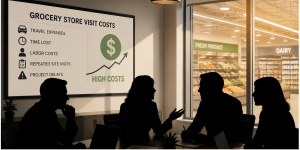
Every remodel or reset wave in grocery starts the same way: a round of site visits before a single piece of work gets scoped. An estimator walks the store to confirm dimensions. An architect re-measures a sales floor that was already measured for the last reset. A refrigeration contractor drives out to verify rack capacity before pricing the job. Each visit costs time and money, and most of them are re-verifying something the organization has already captured once, just not in a form anyone can find or trust.
1. Start with a validated capture, not another walkthrough
The first step in cutting site visits is treating existing-condition capture as an asset, not a one-off task tied to a single project. A Phygital Twin, built from a high-fidelity capture of the store, including refrigerated case layouts, dairy and deli equipment, backroom coolers, and dock conditions, gives every future initiative a current, validated starting point. Instead of re-measuring the sales floor for this reset because last year's survey lives in someone's project folder, the team pulls from one living record that already reflects what is really there.
2. Give your team a virtual walkthrough before anyone drives to the store
Estimators and project managers do not need to be on site to check whether a new freezer will clear an existing dock opening or verify aisle widths against a planned reconfiguration. A current, navigable view of the store lets that early scoping work happen remotely. The site visit that used to happen in week one of a program moves later, or disappears entirely, because the questions it was meant to answer are already answered.
3. Equip vendors and contractors with the same site truth
Refrigeration contractors, case vendors, and equipment installers traditionally need their own site visit to price a job accurately. When those vendors work from the same validated capture as the internal team, they can confirm refrigerant line routing and floor drain locations without scheduling a separate trip. That means fewer vendor visits stacked on top of internal ones and bids that reflect real conditions instead of assumptions corrected after the contract is signed.
4. Reuse the capture across every future initiative
The real savings show up over time, not on a single project. A store captured once for this remodel becomes the reference point for next year's private label reset, the Facilities team's preventive maintenance planning, and due diligence work if the site is ever considered for a format change. “Capture once, reuse everywhere” means the second, third, and fourth initiative at that store starts from a current record instead of commissioning a new survey.
5. Know when a visit is still worth it
This is not a case for eliminating site visits altogether. Final walkthroughs, safety verifications, and complex structural conditions still call for someone standing in the store. The goal is to remove the redundant visits, the ones that exist only because the last capture was outdated, incomplete, or impossible to find, so that the visits that do happen are the ones that genuinely need a person on site.
“The programs that cut their site visits the most aren't skipping steps. They're just not paying to rediscover the same store three or four times a year,” says Nick Bonko, Immersion Data Solutions account executive.
A grocery remodel program does not get faster by asking teams to move more quickly through the same broken process. It gets faster when the information they are working from stops requiring a trip to confirm.