

Grocery remodel and reset programs move fast. A refrigeration swap here, a private label rollout there, a full aisle reconfiguration timed to a seasonal reset. Behind every one of those projects sits a set of decisions based on what is actually in the store today. When that information is outdated or incomplete, the program does not fail all at once. It fails one small surprise at a time, and those surprises land directly in the budget and the schedule.
1. Refrigeration surprises are the most expensive kind
Cold chain equipment sits at the center of nearly every grocery remodel. Refrigerated and frozen cases connect to compressor racks, condensers, and refrigerant lines that were installed, modified, and patched over years of service calls that never made it back into a master drawing.
When a project team plans a case reset from old equipment schedules instead of current site conditions, the contractor finds refrigerant lines routed differently than expected, floor drains that won’t work with the new case layout, or a compressor rack that cannot support the load the new configuration requires. Each of those discoveries becomes a change order, and change orders are how a program's contingency budget disappears.
2. Reset programs compound small gaps into large costs
Private label rollouts and aisle reconfigurations run against a merchandising calendar that does not move, so any delay in site verification ripples across the entire wave. If Store Planning drawings do not match what is actually on the floor, the reset crew loses time reconciling reality with the plan store by store. That lost time comes out of a schedule that was already tight, and it shows up as overtime, rescheduled trucks, or a store that reopens late.
3. Backroom and receiving realities rarely make it into the plan
Back-of-house conditions are chronically underdocumented compared to the sales floor. Receiving docks, dock doors, backroom freezer and cooler storage, drainage, and electrical panels all get touched by day-to-day operations without those changes flowing back into a master record.
When a remodel team plans around outdated schematics, they discover during construction that a dock door will not clear the new equipment delivery or that a backroom compressor's location conflicts with electrical work already scheduled. Those are exactly the discoveries that should have been resolved before the project was bid, not after the crew is on site.
4. The pattern shows up the same way every time
When budgets and timelines fail on a grocery program, the postmortem usually points to the contractor, the equipment vendor, or an aggressive schedule. Rarely does it point to the root cause: existing-condition information that was outdated, incomplete, or scattered across separate systems for equipment, layout, and facilities.
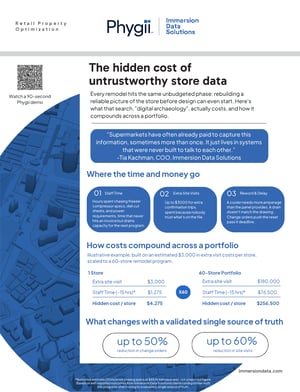
“Grocery leaders are being asked to move faster on remodels and refreshes while the site data they are planning against gets less reliable every year it goes unverified. That gap is where budgets and timelines quietly come apart,” says Tia Kachman, COO of Immersion Data Solutions.
A Phygital Twin closes that gap by capturing every store once, down to case types, refrigeration lines, floor drains, and dock conditions, and keeping that record current as a validated source of truth. Construction, Store Planning, and Facilities all plan from the same site reality instead of reconciling separate versions of it store by store.
“The programs that hit their budget and their date are the ones that stopped treating site verification as something you do on the way into a project. They already know what is in the store before the first bid goes out,” says Immersion Data Solutions account executive Nick Bonko.
Across remodel and refresh programs, Immersion Data Solutions has reported reductions in change orders and planning costs of up to 50 percent, alongside meaningful acceleration in store opening timelines.
Your next reset or remodel does not have to start with a guess about what is really in the store. When the existing-condition picture is current and validated, budgets hold, timelines hold, and the surprises that used to eat both simply stop showing up.