Pavement Condition Assessment

Pavement condition assessment for multi-site retailers

You know which parking lots look bad. Know which ones to fix first.

Get a consistent view of pavement conditions across locations, then add Pavement Condition Index (PCI) scoring, recommendations, estimated cost, and portfolio prioritization when you need deeper capital-planning intelligence.

new-pavement-banner (1)
Up to 90%

Lower cost per lot vs. traditional PCI assessment

1,300+ acres

 Of client parking lots represented in model training 

300,000+

 Used to train the pavement model 

ASTM D6433

methodology used to calculate PCI 

Turn pavement condition into a capital decision

Facilities teams have to keep properties safe, protect the customer experience, manage limited capital, and decide which projects should move forward now versus later.

Parking lots sit directly in that responsibility. Customers expect a safe, well-maintained environment, and parking lots are one of the physical assets that determine whether Facilities delivers on that expectation.

The challenge is scale. A visibly damaged lot is easy to notice. Comparing 100, 500, or 1,000 locations consistently is much harder.

Immersion Data Solutions gives you a scalable way to document pavement conditions across locations. From there, Phygii can layer on deeper analysis when you need to move from condition visibility to capital planning.

Hero or pic 2 option png (1)

What is a Pavement Condition Assessment?

A Pavement Condition Assessment gives Facilities teams a consistent view of pavement conditions across locations so they can identify needs, compare sites, and plan maintenance or capital work.

Immersion Data Solutions captures high-fidelity drone imagery and documents pavement condition at each site. Depending on the level of analysis you need, the assessment can range from standardized visual condition ratings to AI-generated PCI, treatment recommendations, estimated cost, and portfolio prioritization.

Choose the level of pavement intelligence you need

Every pavement program starts with consistent site evidence. How far the analysis goes depends on the decisions you need to make.

Condition visibility

For teams that need a consistent, scalable view of parking lot conditions.

  • High-fidelity drone imagery
  • Supporting photography
  • Major defects documented
  • Certified Imagery Specialist assessment
  • Standardized 1–5 condition rating
  • Site-level evidence
  • Portfolio condition roll-up

Use this level to establish a baseline, identify obvious needs, document current conditions, or support routine Facilities decisions. The visual-first assessment provides full-surface capture, documented defects, and condition information that can be compared across locations.

PCI + planning intelligence

Add deeper analysis when you need more rigor for capital decisions.

  • AI-generated Pavement Condition Index (PCI)
  • Automated pavement distress detection
  • Recommended treatment
  • Timing and urgency
  • Estimated cost
  • Safety or accessibility considerations
  • Portfolio ranking and prioritization
  • Budget-planning tools

Use this level to compare competing pavement needs, build a capital business case, and determine which locations should receive investment first.

From site evidence to portfolio decision

1

Capture

Immersion Data Solutions captures the parking lot using high-fidelity drone imagery. If you already have recent imagery that meets the requirements for pavement analysis, we may be able to use it.

2

Understand condition

Certified Imagery Specialists can provide a standardized 1–5 condition rating. With PCI analysis, AI detects pavement distress and calculates PCI using ASTM D6433 methodology.

3

Add decision intelligence

Phygii adds recommended treatment, timing, estimated cost, and configurable planning assumptions when deeper planning support is needed.

4

Prioritize

Compare locations to identify which sites need attention first, where preventive work may preserve the asset, and where safety or other considerations should elevate urgency.

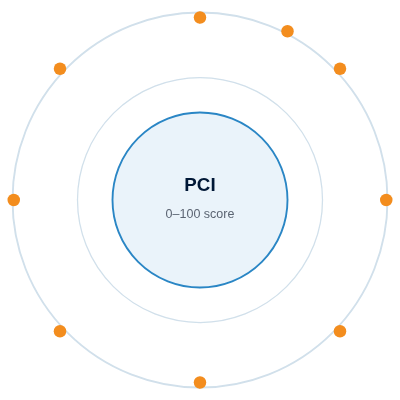
14-pci-score-gauge

See what is driving pavement condition

When PCI analysis is included, Phygii detects pavement distress directly from the captured imagery, including:

  • Longitudinal cracking
  • Alligator cracking
  • Potholes
  • Raveling
  • Edge deterioration
  • Transverse cracking
  • Block cracking
  • Patching
  • Bleeding

The result is more than a score. You can see the evidence behind the assessment and understand the conditions contributing to the PCI.

See how pavement assessment works in Phygii

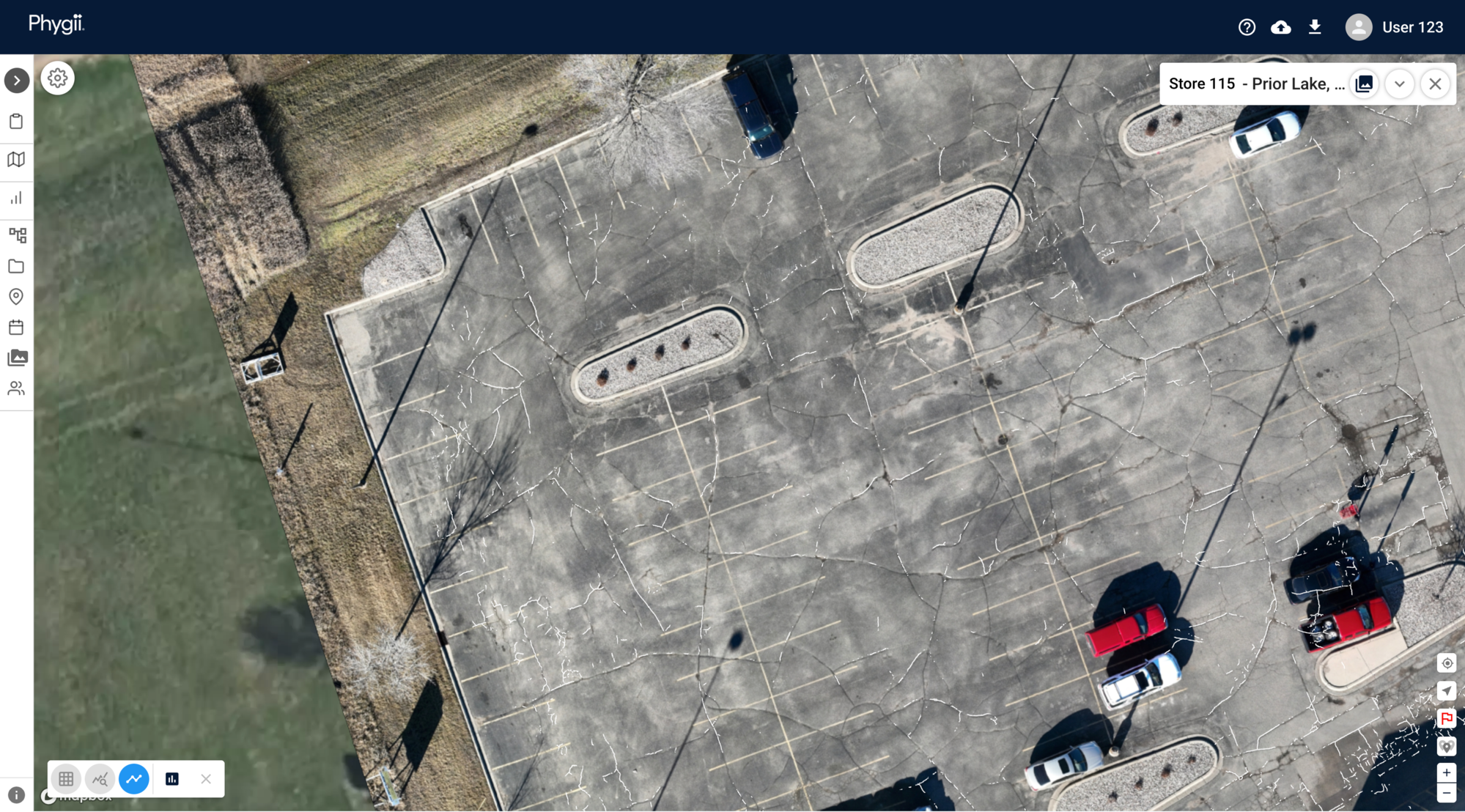
pci segmentation zoom in 1 edited
1. See the evidence

Review the drone imagery used to document pavement conditions. 

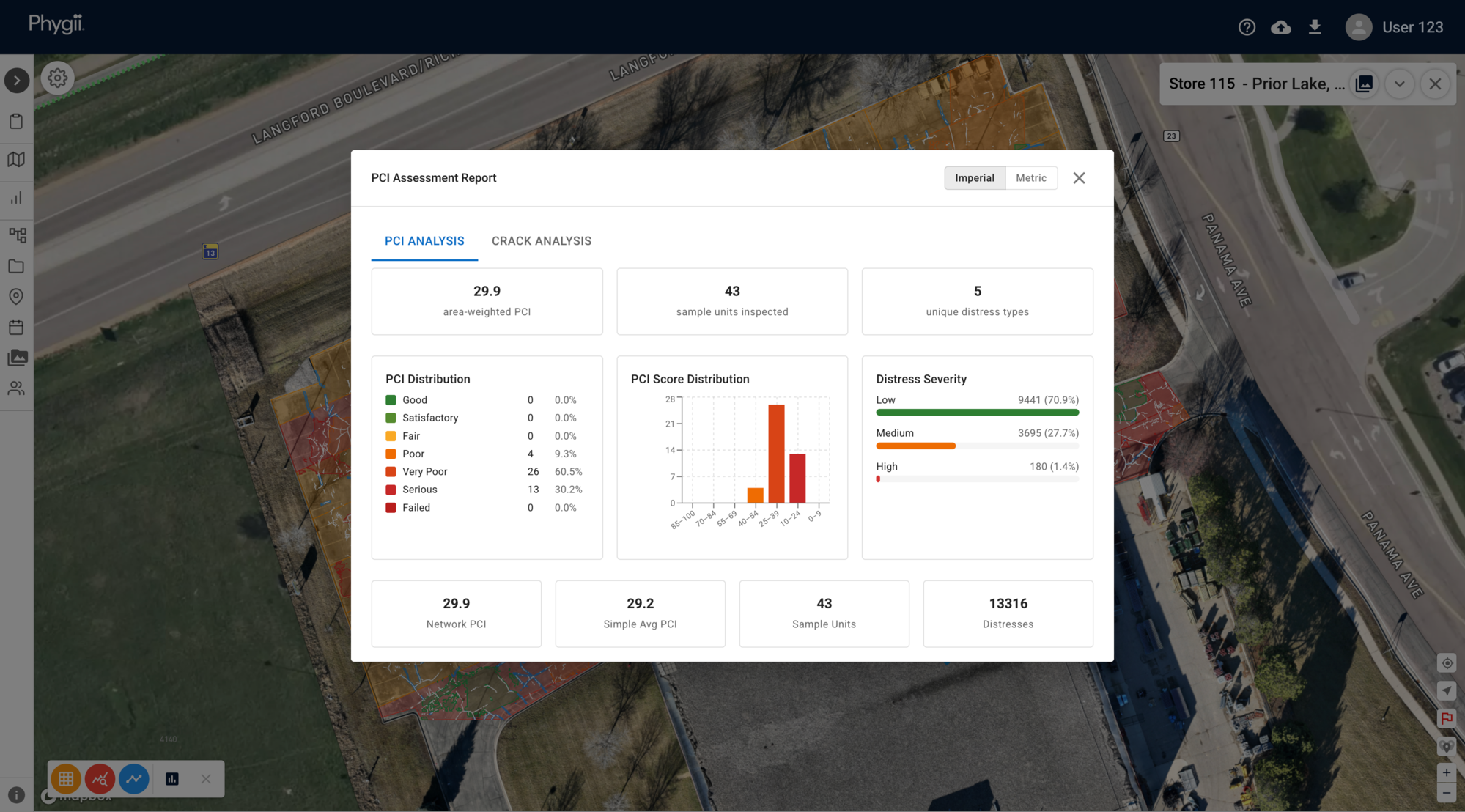
pci assessment report 1 edited
2. Understand current condition

See a visual condition rating or PCI, depending on the level of assessment.

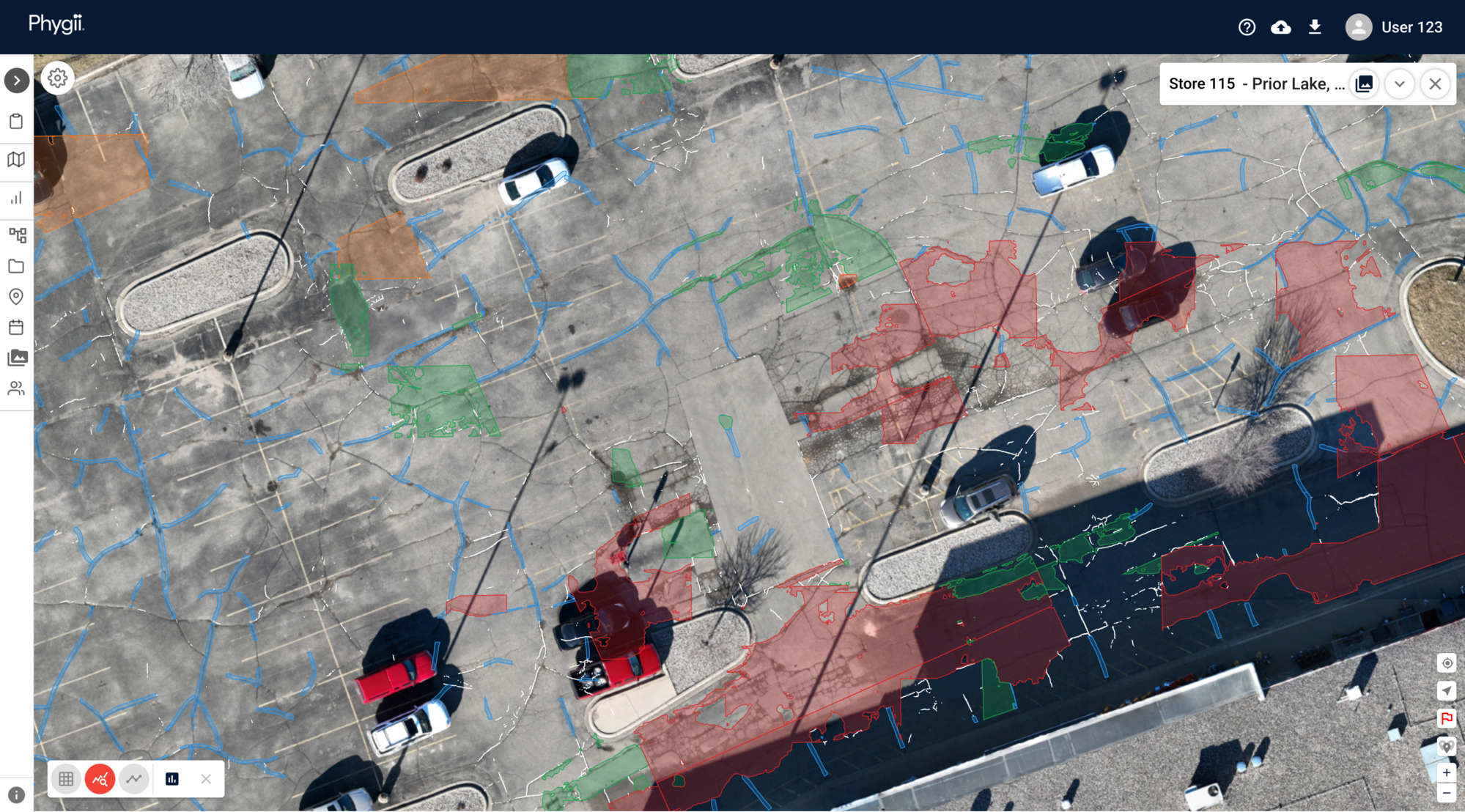
pci detection zoom in 1 edited
3. See what is driving the result

Review detected pavement distress alongside the supporting imagery.

4 new (1)
4. Understand what to do next

Review recommended treatment, timing, and estimated cost.

5 new (1)
5. Compare locations

See which assessed locations require attention first.

6 new (1)
6. Plan across the portfolio

Evaluate priorities and budget scenarios using configurable assumptions.

Ready to see it on your own portfolio?

Walk through pavement assessment in Phygii with your own locations.

Objective data. Human decisions.

Phygii automates work that is difficult to perform consistently across a large portfolio without taking the decision away from your Facilities team.

Your team defines the program. Immersion Data Solutions captures the sites. Certified Imagery Specialists assess condition, and AI can add PCI and distress analysis. Phygii provides recommendations and planning intelligence. Your team reviews the results, adjusts assumptions based on what you know about your properties and markets, and makes the final capital decisions.

Optional civil-engineer QA is available when additional professional review is appropriate.

That ability to turn large amounts of property data into clearer answers matters. One enterprise Facilities leader specifically identified objective rankings as a way to reduce the “analysis paralysis” that can make capital decisions unnecessarily difficult.

What better pavement intelligence helps you do

3 (2) (1)
Establish a consistent baseline
Document pavement conditions across locations using a common capture and rating approach.
4 (3) (1)-1
Defend capital priorities
Show why one location should move ahead of another with consistent condition data and supporting evidence.
5 (2) (1)
Find preservation opportunities
Identify pavement that may benefit from preventive intervention before deterioration leads to more expensive work.
6 (2) (1)
Keep safety visible
Consider safety and accessibility concerns alongside pavement condition when determining urgency.
7 (2) (1)
Spend less time analyzing
Give Facilities teams decision-ready information instead of another dataset they have to manually reconcile.

In pavement-planning discovery, a major multi-site retailer identified consistent scoring, estimated cost, and portfolio ranking as its most important near-term outputs.

See a complete sample assessment

Want to see the full output?

See how pavement imagery becomes condition intelligence, recommended action, estimated cost, and portfolio priorities from start to finish.

Pavement is only one part of your Facilities portfolio

Parking lots compete for attention and capital alongside roofs, HVAC, lighting, paint, building systems, safety needs, and other physical assets. Phygii helps Facilities teams understand what is true on the ground, compare needs across locations, and make better decisions with fewer surprises.

Ready to see how far your pavement program could go?

Start with consistent pavement-condition visibility, then add PCI, recommendations, estimated cost, and portfolio prioritization when you need deeper planning intelligence.

Frequently asked questions

What is a Pavement Condition Assessment?

A Pavement Condition Assessment provides a consistent view of pavement conditions across locations. It can include visual condition ratings, PCI, distress detection, treatment recommendations, estimated cost, and portfolio prioritization depending on the level of analysis you need.

The Pavement Condition Index is a standardized 0–100 rating of pavement condition based on the type, severity, and extent of visible pavement distress. Higher scores indicate pavement in better condition. PCI creates a consistent basis for comparing pavement across locations.

No. Immersion Data Solutions can document pavement condition using drone imagery and standardized visual ratings without performing a full PCI analysis. Add PCI, automated distress detection, recommendations, estimated cost, and planning tools when you need deeper decision support.

Phygii can detect longitudinal, transverse, alligator, and block cracking, as well as potholes, patching, raveling, bleeding, and edge deterioration. These detected conditions help explain what is driving pavement condition and PCI.

Immersion Data Solutions captures high-fidelity drone imagery. AI analyzes visible pavement distress in that imagery and calculates PCI using ASTM D6433 methodology.

How accurate are Phygii’s PCI scores?

In comparative testing, model-generated PCI scores have been within 5% of professional ASTM review of the same drone imagery. Repeated analysis of the same imagery has produced 95% agreement between PCI outputs. Optional civil-engineer QA is available.

Traditional professional PCI assessments provide rigorous pavement analysis but can be costly to deploy across large portfolios. Immersion Data Solutions uses drone capture and AI-assisted analysis to make consistent PCI assessment practical at multi-site scale.

Immersion Data Solutions typically performs the drone capture so imagery meets the requirements for the selected assessment. If you already have recent drone imagery captured at sufficient fidelity, we can review it to determine whether it can be used.

Outputs depend on your scope. Every program can include pavement imagery, condition documentation, and site-level evidence. Deeper programs can add PCI, automated distress detection, recommended treatment, timing, estimated cost, and portfolio prioritization.

Phygii lets you compare locations using consistent condition data. With planning intelligence, you can also compare recommended action, estimated cost, and priority while applying your own planning assumptions and considering factors such as safety.