
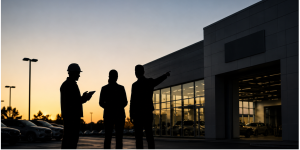
Every trip back to a store that's already been visited is money that doesn’t go toward the next site. But that's easy to miss when the trips are split across different teams and different budgets. Real Estate sends someone to evaluate a new or converted location, while Construction sends someone back months later to scope a retrofit. Depending on the business, that retrofit might involve service bays, equipment, electrical capacity, storage, EV charging, customer-facing space, or exterior improvements. They visit the same store within the same year, but none of them are working from what the others found.
Why this isn't a scheduling failure
In a sense, repeat visits make sense. Each initiative has its own scope and its own funding, and each team is measured on its own outcome, not on minimizing trips across the portfolio. The fastest way for any one team to get reliable information is to send someone to go look.
Underneath that are two structural issues. First, data from past programs wasn’t built to be reused. Photos of electrical panels and equipment areas sit in a drive under a project code from two years ago, while the latest site layout exists in CAD, and only one person has the current version of. Second, every capture is designed as a one-off. The team documenting a service-area or equipment upgrade captures exactly what that project needs and nothing more. The next team, scoping EV charging readiness at the same location, starts from zero.
What repeat visits cost, concretely
If a brand runs three major programs a year across 500 locations, high-priority stores may get three or more visits inside a 24-month window. Each visit can carry significant travel and planning costs and produces a small island of data that helps one project and nothing after it. That adds up to six figures in avoidable fieldwork, and months of time waiting for each program's own site-visit phase to clear before crews can move.
When that pattern is replaced with a single validated capture, site visits and planning costs typically drop by around half. By not re-evaluating the same locations, the team can evaluate more candidate locations in a comparable window.
Capture once, reuse everywhere
The fix isn't creating a blanket limit on store visits and hoping for the best. It's changing the question asked before anyone gets sent at all: If we're going to stand at this location anyway, what do the next two or three programs need us to capture, not just this one?
A well-planned capture could include electrical panels, ventilation, equipment and fixture footprints, service areas, exterior conditions, and more. The same information can support a conversion, remodel, equipment upgrade, facilities project, or compliance audit. The capture becomes a living site record instead of a project artifact. Construction, Facilities, and Store Planning can all pull from one source instead of commissioning their own version.
This doesn't mean site visits disappear. Final walkthroughs, safety verification, and complex structural conditions still need someone physically there. The goal is to eliminate the visits that only exist because the last capture was outdated, incomplete, or impossible to find.
Where to start
This works alongside the systems and vendors already in place. It doesn't require standardizing every team's processes or replacing existing survey relationships. Most programs start with a single initiative already on the calendar, like an equipment upgrade, location conversion, remodel, or facilities assessment. Once the reduction in repeat visits and planning time is visible, the program can expand.
"The programs that cut their site visits the most aren't skipping steps. They're just not paying to rediscover the same store three or four times a year," says Nick Bonko, Immersion Data Solutions account executive.
An automotive property program doesn't move faster by pushing teams through the same process more quickly. It moves faster when the information they're working from stops requiring a trip to confirm.
See how Phygii turns a single site capture into a reusable record every program can work from.