
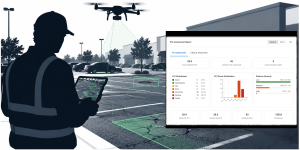
New machine-learning analysis helps Facilities teams move from a condition score to a funded capital plan.
It doesn’t take machine learning to know a parking lot full of potholes has a problem. The hard part is when you're responsible for hundreds of lots, all competing for the same capital budget.
Which ones need attention first? Which can wait a year? What should you actually do at each one? And how much should you plan to spend?
Phygii's Pavement Condition Assessment now helps Facilities teams answer those questions with a new layer of machine-learning analysis and portfolio planning tools.
Immersion Data Solutions already captures parking lots using high-fidelity drone imagery. Certified Imagery Specialists, or CIs, review that imagery and apply a standardized 1-to-5 condition rating. That approach still works well for many programs, and it isn't going away.
Phygii now adds a deeper layer using machine learning to detect pavement distress and calculate a Pavement Condition Index (PCI) score. Analyzing PCI scores at scale helps you move from a score to a recommended treatment, estimated cost, and ranked list across your whole portfolio.
This is an extension of Pavement Condition Assessment, not a replacement for it. Not every parking lot or program needs the same depth of analysis. The right level depends on the decision in front of you.
What the machine-learning model actually sees
From drone imagery, the model looks for nine specific types of pavement distress: longitudinal cracking, transverse cracking, alligator cracking, block cracking, potholes, patching, raveling, bleeding, and edge deterioration.
Each one points to a different cause and a different fix. A patch of alligator cracking usually signals a structural problem below the surface. A pothole often means water got underneath the pavement and froze. Patching shows someone already tried to fix something, and raveling means the surface itself is breaking down.
The model was trained on more than 300,000 images across more than 1,300 acres of client parking lots, so it can apply the same standards to a lot in Phoenix and a lot in Minneapolis.
Ryan Kohlman, product lead at Immersion Data Solutions, said, "We didn't want a black box that just spits out a score no one can explain. The model shows you exactly which cracks and defects it found, so a Facilities team can see the evidence behind the number and feel confident about the decisions the number drives.”
Those detected distresses feed into the Pavement Condition Index, or PCI, calculated using ASTM D6433, a widely used pavement engineering standard. PCI is a 0-to-100 score. A higher number means better condition.
That gives Facilities teams a standardized number to compare every lot in the portfolio rather than a simple “good, fair, or poor” rating system.
Using PCI to make portfolio-level decisions
Knowing that one lot has a PCI of 42 and another has a PCI of 71 is useful. It still doesn't tell you what to do, when to do it, what it will cost, or how to prioritize your repairs.
That's where Phygii goes beyond the score itself. The platform can recommend a treatment based on what's actually driving the number, whether that's monitoring, preventive maintenance, a seal coat, an overlay, or full reconstruction. It can suggest timing, so you know whether a lot needs attention this year or can wait. And it can generate an estimated cost, so every location on your ranked list comes with a number attached, though it isn't a substitute for a contractor's bid.
A location with a safety concern, like a damaged drive aisle or sidewalk, may need to move up the list even when its score isn't the worst in the portfolio. Phygii is built to let a Facilities team apply that kind of judgment without changing the underlying condition score.
Traditional PCI assessments performed by pavement engineers are rigorous, and that rigor still matters. The challenge has always been doing that kind of assessment across hundreds of locations without turning it into a years-long project.
“That's the gap this machine-learning layer is built to close,” says Kohlman. “It allows for the same kind of standardized, defensible scoring, but delivered at scale and at a cost that makes sense for a full portfolio.”
The model's PCI scores land within 5% of a professional ASTM review of the same imagery, with 95% agreement between repeated analyses of the same imagery. Assessing a portfolio this way can also cost up to 90% less per lot than a traditional PCI assessment, and turn around in weeks, not months.
In buyer conversations, Facilities and portfolio leaders have pointed to this kind of uniform scoring as a fast way to spot the properties that need a closer look, without spending hours manually reconciling site-by-site reports.
Using PCA in budget negotiations
The process still starts and ends with people. Immersion Data Solutions captures the imagery. Machine learning detects distress and calculates PCI. Phygii turns that into recommendations, cost estimates, and planning tools. Then your Facilities team reviews the output, applies what it knows about its properties, vendors, and budget, and makes the final call. Optional civil-engineer review is also available when a project needs an added layer of professional sign-off.
Tia Kachman, chief operating officer of Immersion Data Solutions, said, "The goal was never to take the decision away from Facilities teams. It's to give them a defensible starting point for budgeting conversations."
Next steps
If you’re ready to move from condition to planning and budgeting in a consistent way across every site in the portfolio, see firsthand how Pavement Condition Assessment in Phygii works or learn more about how it’s benefiting retailers.