

You just found out your store refresh calendar is moving up. The walk-in freezer and reach-in coolers need to come out sooner than planned, the deli case is moving to make room for an expanded bakery footprint, and leadership wants a rollout plan for the first wave of stores by quarter-end.
On paper, the path looks clear. Confirm the store list. Finalize the layout. Get design and construction moving.
But before anyone can finalize a floor plan, someone asks, “What do we actually know about these stores today?” That is when the work stops being program leadership and turns into what Immersion Data Solutions Account Executive Nick Bonko calls “digital archaeology”: chasing freezer specs, deli case dimensions, bakery equipment power requirements, and racking layouts from disparate, disconnected sources.
The hidden phase every grocery program hits
Project plans list steps like kickoff, design, permitting, and mobilization. What they leave out is building a reliable, current view of the stores about to be touched. It’s the step everyone feels but no one names. Before the work begins, teams have to go digging through records, checking whether the equipment listed on file matches what is on the floor, and calling vendors to see if the racking layout from the last reset still works.
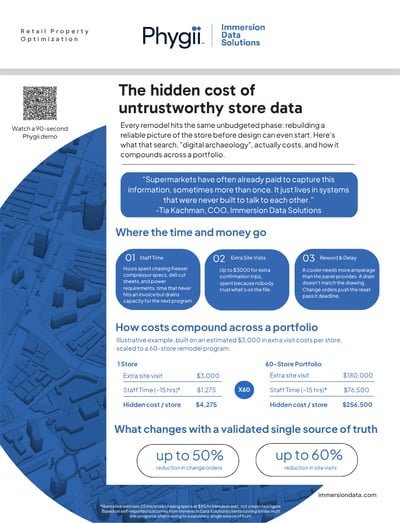
"Supermarkets have often already paid to capture this information, sometimes more than once. It just lives in systems that were never built to talk to each other," says Tia Kachman, COO of Immersion Data Solutions.
The information exists. It is scattered across CAD files, PDFs, spreadsheets, and whatever systems Facilities, Construction, and Store Planning each used last. The data was captured at different times with no simple way to confirm what is still accurate. Every new program rebuilds the same picture from scratch, and nobody budgets for that work even though everybody ends up doing it.
Where the time and money actually go
Follow the hours and the invoices, and a pattern shows up across three areas.
Staff time is the first. Hours spent chasing freezer compressor specs, deli case cut sheets, and power requirements eat up time that never appears on an invoice but comes directly out of the team’s capacity to run the next program.
Extra site visits are the second. As much as $3,000 is spent on each confirmation trip because nobody trusts what is on file for a given cooler line.
Rework and delay are the third and often the most expensive. A crew installs a new reach-in cooler and finds the electrical panel does not have the amperage it needs, or a deli case goes in and the floor drain doesn’t match the drawing. They file a change order and the redesign cycle pushes the reset past the date leadership was counting on. The program is approved but not moving.
This is not a store operations problem
The instinct when overruns show up is to tighten the process. Most teams start with stricter checklists, better vendor briefs, or more accountability for documentation. Those are reasonable moves, but they target the wrong layer. A program can have a sharp project manager and a disciplined general contractor and still lose weeks if the freezer specs, deli equipment, and racking drawings all live in separate systems.
Grocery programs are not slow because teams are careless. They are slow because every program rebuilds the starting line from scratch.
What changes when you can trust your store data
Picture pulling up a current, validated view of every store in scope before the first kickoff meeting. From your desk, you can view layouts, freezer conditions, and POS displays without accessing dozens of project folders. This single source of verified truth allows Construction, Facilities, Real Estate, and Store Planning to work from the same resources.
"When every team is looking at the same validated data, the conversation shifts from arguing about what is true to deciding what to do about it," says Bonko.
Put a number on the search before you plan the next reset
The most useful next step is not another project management tool. It is an honest number on what the hunt for store information is costing today. Include store count, programs per year, a defensible site visit cost, and a realistic estimate of delays.
Immersion Data Solutions clients running similar multi-site programs have seen up to a 50 percent reduction in change orders and a 60 percent reduction in site visits after moving to a validated, single source of truth. (Results based on self-reported client outcomes from Immersion Data Solutions.)
The problem underneath the delays is not a people problem or a project plan problem. It is a store data problem, and once grocery leaders quantify the costs, they can tackle the heart of the issue before the next reset begins.