
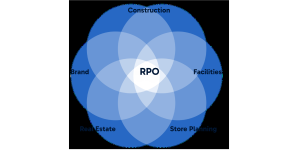
If you work with a large retail property portfolio, you know that every remodel, refresh, or maintenance program seems to start from scratch. Teams chase down drawings. Someone has to “just go see the site.” Reports live in PDFs on shared drives. By the time you’ve pulled the data together, half of it is out of date.
That gap between what’s really happening in your stores and what your systems can show you is exactly why a new practice has emerged: Retail property optimization, or RPO.
From “projects and PDFs” to a connected retail portfolio
Traditional retail property work is project-centric:
- You spin up a remodel or maintenance program.
- Vendors capture data and produce reports for that one initiative.
- Those files are stored, forgotten, or recreated the next time you need information on the site.
This way of working generates a ton of data but almost no reusable intelligence. Your leaders of Construction, Facilities, Brand, and other teams are still making high-stakes decisions with fragmented, incomplete views of your properties.
Retail property optimization flips that model.
RPO acknowledges that your organization has made huge investments in property and relies on its local presence to drive omnichannel success. It treats your property data as a single, living system to be seen, managed, and improved over time. In practice, that means:
- Capturing real, high-fidelity conditions across every site.
- Structuring that information into a “Phygital twin” of every site in the portfolio.
- Making it searchable, reusable, and ready to power dozens of initiatives across the full property lifecycle: acquire, operate, refresh, and divest.
A working definition of retail property optimization
At Immersion Data Solutions, we define retail property optimization as:
A portfolio-wide approach that turns fragmented site data into a single, living source of truth, so multi-location retail leaders can make faster, smarter decisions that grow revenue, improve the customer experience, increase cost savings, and protect asset value.
An RPO platform like Phygii sits at the center of that approach. It combines:
- Reality capture and modeling: drones, lidar, walkthroughs, photos, CAD/BIM and more, merged into an accurate, navigable twin of each site.
- Portfolio-wide, accessible data: a connected, data-rich model of every property in the network that lives in one system.
- Live, decision-ready context: queryable data layers tied to real assets and conditions, so leaders can ask and answer questions across hundreds of locations at once.
The outcome is simple but powerful: capture once, reuse everywhere.
Instead of writing off property costs as overhead, companies can see where their risks and opportunities are and get ahead of them. Instead of sending people back to the same stores again and again, you tap the same trusted portfolio twin to support remodels, maintenance, brand compliance, accessibility checks, divestment prep, and more. Instead of making decisions in a vacuum, you can have all the information you need at your fingertips.
Why RPO exists now
Three big shifts are driving the need for RPO:
- Rising pressure to do more with less
Customer expectations continue to rise alongside expectations to deliver more, faster. Repeating surveys and site visits just to “see what’s there” is becoming impossible to justify. - An explosion of built-environment data
Retailers are capturing more imagery and measurements than ever, but most of it sits in silos or static reports. There’s no easy way to see the portfolio in one place and act on it. - A shift from projects to programs
Many retailers are moving from one‑off remodels to continuous portfolio programs. That demands tools that see across hundreds of stores, not just one site at a time.
RPO is the natural response: a discipline built specifically for multi-location retailers that need portfolio‑wide visibility.
What an RPO platform actually does
An effective RPO platform should help you:
1. See real conditions across the portfolio
Instead of piecing together drawings, photos, and local knowledge, an RPO platform gives you a current, navigable twin of each site, from parking lots to signage and more.
You can:
- Walk a store virtually before a single vendor shows up.
- Verify dimensions and conditions without paying for another site visit.
- Compare similar sites side by side to prioritize investments.
2. Run programs from one living source of truth
An RPO platform connects that site‑level view into a portfolio‑wide model with advanced analytics and AI features, so you can ask questions like:
- “Which 250 stores are most ready for this new format?”
- “Where do we have ADA or brand compliance gaps we can tackle in this year’s budget?”
- “Which roofs or parking lots are most at risk over the next 12–18 months?”
Because every initiative pulls from the same data foundation, you avoid the classic problem of each team commissioning its own surveys and reports.
3. Accelerate timelines and reduce cost
When portfolio leaders can trust the data they already have, they can:
- Cut repeat site visits and duplicated assessments, reducing per-site planning expenses by as much as 80%.
- Shorten remodel and refresh programs, bringing uplifted stores online months earlier.
- Reduce store downtime, shaving weeks off closure windows by resolving issues before they hit the field.
4. Align every team around the same picture
RPO isn’t just about better CAD or nicer visuals. It’s about giving Construction, Facilities, Brand, Real Estate, Store Planning and Merchandising teams one shared, always‑on context to work from.
That means:
- Less version confusion between drawings and reports.
- Reduced friction between corporate and field.
- Clearer tradeoffs when you’re allocating capital across the network.
How RPO compares to the status quo
If you’re wondering how RPO is different from other approaches, a useful way to think about it is:
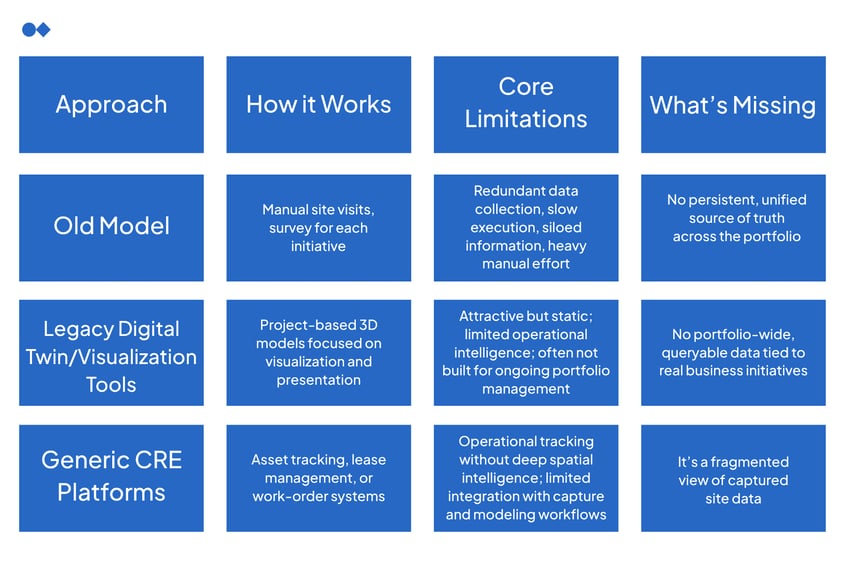
RPO platforms like Phygii are explicitly built to close that gap for multi-site retailers:
- Retail‑specific, portfolio‑wide phygital twins.
- Capture‑once, reuse‑everywhere data model.
- Tight integration of capture, modeling, and analytics in a single stack.
- Initiative templates and data foundations mapped to the real retail lifecycle: acquire, operate, refresh, divest.
Why RPO should be on your roadmap
If you’re responsible for a 100+ site retail portfolio, RPO isn’t a buzzword, it’s a practical way to stop re‑capturing what you already own, and start making portfolio decisions with the same clarity and speed as your digital counterparts do.
Done well, RPO lets you:
- Move faster with fewer surprises.
- Spend capital where it has the most impact.
- Protect and grow asset value.
- Deliver a more consistent, on‑brand experience across every store in the network.
That’s what retail property optimization is really about and why leaders across traditional retail, convenience, auto service, and telecom are starting to treat it as a must‑have capability, not a nice‑to‑have tool.