

How retail leaders move from pilot wins to enterprise-wide impact
In most large retail organizations, property decisions are still made one project at a time. A new store prototype here. A remodel wave there. A brand refresh layered on top.
Each project does its own site surveys, its own documentation, its own decision-making. The result? You pay over and over just to see what you already own, and every major program carries more friction, risk, and delay than it should.
Retail property optimization (RPO) is about changing that, turning site data, phygital twins, and lifecycle intelligence into a reusable asset that supports every initiative across the portfolio.
But RPO doesn’t become an enterprise-wide approach in one move. In practice, every retailer moves through a series of maturity stages as they go from a single pilot to a truly enterprise-wide discipline.
“Most of our customers didn’t wake up one day saying, ‘We need retail property optimization.’ They woke up saying, ‘We can’t keep running multi‑million‑dollar programs on spreadsheets and old site photos.’” says Mike Loukusa, Founder and CEO of Immersion Data Solutions. “RPO is the name for the system that fixes that.”
This article outlines a 5‑stage RPO maturity curve we see across multi-location retailers and how leaders can use it to pinpoint where they are today, expand successful work into other departments, and build toward an enterprise operating model where RPO is as fundamental as CRM or ERP
Stage 1: Fragmented & field-dependent
At stage one, property programs are run as one‑offs. Each initiative spins up its own site visits and surveys. Real Estate, Construction, Facilities, Brand, and Store Planning each maintain separate spreadsheets, PDFs, and photo folders. Site information is locked in static files tied to a single project, not in a reusable, portfolio-wide view.
Leaders feel this as constant friction and unnecessary costs. Repeat travel to confirm existing conditions. Change orders and rework when site realities don’t match old drawings. Slow decisions because no one trusts that they’re looking at the latest information
In this stage, it’s common to hear, “Didn’t we just survey that store?” or “We’ll need to send someone back out to be sure.”
This is where most organizations start and it’s exactly why a small, well‑chosen RPO pilot is the right first move.
Stage 2: Pilot RPO
Stage two is where retail property optimization enters the picture in a controlled way.
“We almost never start with a big RPO conversation. We start with one painful program like a remodel, compliance audit, or signage refresh. Once that’s working better, leaders can suddenly see five or six other places where the same intelligence would pay off,” says Nick Bonko, account executive at Immersion Data Solutions.
The next step is to capture high-fidelity site data for that subset of locations, build phygital twins and structured site records, and use those assets to plan, coordinate, and validate the chosen initiative
The benefits show up quickly for that team. Fewer repeat site visits, fewer change orders due to surprises in the field, and smoother handoffs between teams.
At this stage, the story is still one-dimensional. “We’re using Phygii on this program, and it’s making our lives easier.”
That’s okay. The goal of stage two isn’t to transform the enterprise, it’s to build undeniable proof in one lane.
For senior leaders, the key question at stage two is, “What other initiatives can we use this data in and what kind of results could we get?”
Stage 3: Multi-phase adoption
At stage three, the team that piloted RPO stops seeing it as “a tool for Program X” and starts seeing it as the way they manage their piece of the lifecycle.
The same core group now uses RPO across multiple lifecycle phases for example instead of just one program.
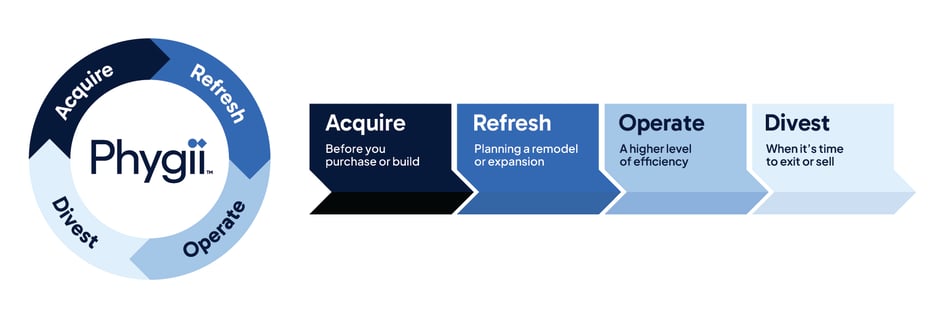
Within that department, the RPO platform becomes the default way to understand a store or subset of stores because it centralizes the full context of a store design, layout, brand expression, materials, and real-world constraints in one place.
At this stage, you’ll see consistent savings and acceleration across multiple initiatives, fewer internal scrambles to find data, and a growing appetite from adjacent teams who see the impact and want in.
Stage 4 – Cross-functional RPO
Stage four is where RPO stops being “owned” by a single department and starts serving as the connective tissue across functions.
Multiple teams actively use the platform, reducing friction across departments, improving coordination across initiatives, and giving decision makers a full-lifecycle system of record for long-term capital forecasting.
What this looks like day to day:
- Site review, test-fits, and entitlement work are driven from the same twin and data set that Remodel and Refresh teams use.
- A&E and signage packages are aligned to accurate, current field conditions – before plans hit the ground.
- Operations and Facilities use the same asset and condition data to prioritize maintenance and compliance work.
- Brand teams use RPO to validate standards across thousands of locations without constant travel.
The effect is faster planning cycles with fewer field dependencies, faster program completions, fewer rework instances, and far better documentation accuracy across locations.
Most importantly, decisions start to change. Multi-department program reviews anchor on a shared portfolio view. Leaders prioritize investment based on real, current conditions instead of anecdotes and outdated drawings.
For senior leaders, stage four is where expansion into other departments becomes obvious and natural. The conversation shifts from, “Is this right for us?” to, “How do we use this to manage risk across our entire portfolio?”
Stage 5: Enterprise RPO operating model
At stage five, RPO is no longer a project, a tool, or a departmental initiative. It’s an operating discipline, as foundational as CRM is for customers or ERP is for finance and supply chain.
What that looks like:
- RPO is embedded in enterprise standards, governance, and capital planning.
- All major property-related decisions are made using dynamic, standardized Phygital twins.
- New strategic initiatives start from the RPO portfolio view, not from a new round of disconnected surveys.
At this stage, leaders use RPO to prove and accelerate the ROI of remodel and refresh programs, protect and grow asset value, manage risk, support reinvention at scale.
How to Move from One Stage to the Next
For a senior retail leader, the most important question isn’t “Which stage are we in?” It’s, “What is the smallest, smartest move we can make this year to move up a stage?”
Some practical patterns:
Stage 1 → Stage 2 (Pilot):
- Pick a high-visibility, high-friction program (e.g., a remodel wave, signage refresh, or new prototype rollout).
- Define clear before/after metrics (site visits, planning time, change orders, program timelines).
- Run a focused RPO pilot with Immersion Data Solutions and document the outcomes.
Stage 2 → Stage 3 (Departmental, Multi-Phase):
- Extend RPO from the initial program into adjacent lifecycle phases within the same team.
- Standardize around templates and workflows so you can clearly define how your organization manages the retail property lifecycle for your stores.
- Use internal storytelling to build credibility for the practice.
Stage 3 → Stage 4 (Cross-Functional):
- Convene relevant teams around a shared RPO roadmap.
- Identify cross-functional pain points: A&E coordination, brand compliance, vendor oversight.
- Launch a cross-functional “Phase Two” pilot, focused on a few targeted improvements (e.g., signage coordination, field validation, post-refresh capture).
Stage 4 → Stage 5 (Enterprise Discipline):
- Align RPO with capital planning, governance, and systems strategy.
- Codify RPO in enterprise playbooks, KPIs, and vendor requirements.
- Treat RPO as a long-term capability to fund and grow, not a line item that lives and dies with a single program.
Using the maturity curve to expand RPO in your organization
The RPO maturity curve isn’t a scorecard, it’s a map. It gives you a shared language to use across functions. It helps you frame expansion into other departments as a series of low‑risk, high‑leverage moves, not a risky “big bang.” And it keeps the focus on faster decisions, lower friction, and better outcomes across your entire portfolio.
“The next RPO opportunity is almost never a moonshot. It’s usually a program where you’re about to pay again to learn things you already know about your stores. That’s the perfect place to start,” says Tia Kachman, Chief Operating Office at Immersion Data Solutions.
If you’d like to see how other retailers are moving from pilot wins to enterprise-wide RPO, Immersion Data Solutions can facilitate a short “RPO Path Forward” session with your leadership team using your current initiatives and data as the starting point.