
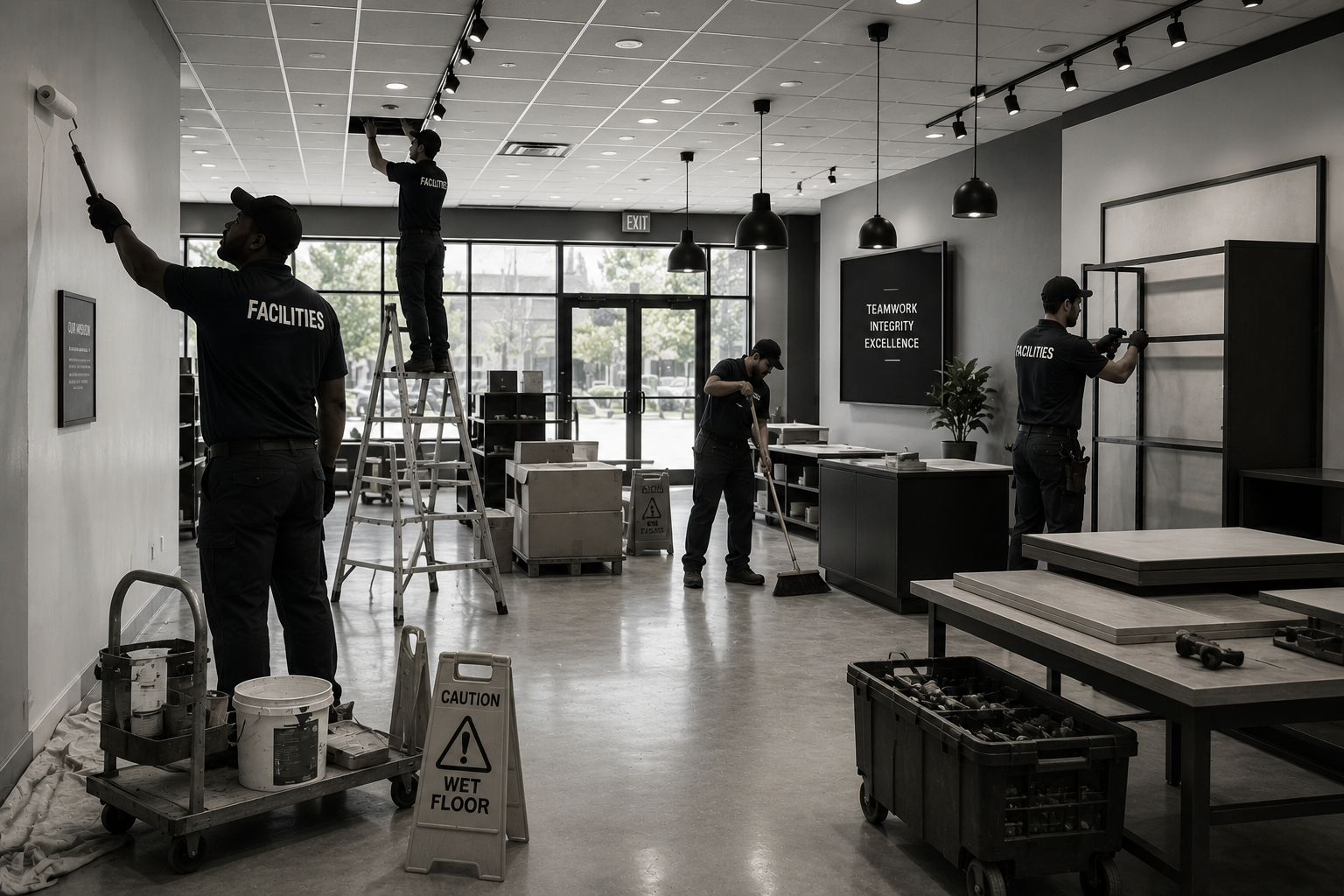
If you look at your maintenance program on paper, it probably looks solid. You have a preventive maintenance schedule and a CMMS full of assets and work orders. You’ve also got national vendors under contract and SLAs in place.
And yet, your week still fills up with hot tickets from stores that can’t wait, scope changes when contractors get on site and see something different than what’s in the drawings, and emergency trips to locations that were supposedly up to spec three months ago.
Your dashboard says, “PM compliance is high”, while your inbox shouts, “We’re always chasing the next issue.”
As Immersion Data Solutions’ Chief Operation Office Tia Kachman explains, “Facilities leaders are being asked to be proactive on top of fragmentary, out‑of‑date store information. That keeps them in fire‑drill mode instead.”
Let’s unpack why that happens, and what a more genuinely proactive Facilities operation actually looks like in practice.
The hidden gap between PM on paper and reality
Most multi‑site retailers have invested real time and money in preventive maintenance.
You have time‑based PM tasks in your CMMS, asset registers for critical equipment, and checklists for recurring inspections
But preventive maintenance assumes that you have an accurate, shared, up‑to‑date understanding of what exists in each store and how it’s actually configured.
“For most retailers I talk to, each new program creates one more folder of surveys and photos that never gets reused. From a Facilities seat, that means you’re constantly paying to rediscover things you already know about properties,” says Nick Bonko, IDS Account Executive.
So even with a preventive maintenance program, you’re often planning work based on incomplete or outdated context, changing scope, and prioritizing work without the full picture.
Your PM program is doing its job. Your visibility is not.
Three structural reasons Facilities lives in fire drill mode
From a Facilities director’s chair, the reactivity usually traces back to three structural issues.
1. Project-by-project views versus a portfolio view
Most of the data you rely on is generated one project at a time. A remodel generates its own survey and as‑builts, a roof program generates its own inspection reports, and an ADA audit generates its own set of findings and photos.
Those artifacts are accurate at the moment they’re created but they’re rarely integrated into a single, living record of the store. It’s not that you aren’t doing the work; it’s that each effort leaves behind another silo.
When a store calls with a problem, you don’t have a single place to see the last remodel scope, existing condition of store assets, or recent PM inspection notes.
You have to stitch that picture together on the fly, creating a reactive fire drill rhythm.
2. PM systems that know when, but not enough about what and where
Traditional PM is good at keeping time‑based tasks from falling through the cracks and ensuring equipment gets touched on a certain cadence.
But time‑based PM on its own doesn’t fully answer questions like:
- “What’s actually in this ceiling bay above the bakery?”
- “What has changed in this back‑of‑house since the last rollout?”
- “What’s the real condition of this roof or parapet wall?”
When your CMMS is decoupled from accurate, accessible site context, it inevitably generates visits where technicians get on site and realize they need extra equipment, lifts, or parts. And without the full picture, you miss the opportunity to spot work that should be bundled or sequenced differently.
3. Siloed views between teams
Even if Facilities has decent data, other teams from Real Estate to Brand may be operating from their own reality.
For Facilities, this fragmentation shows up as work orders that collide with construction schedules or brand rollouts, or as conflicting information about layouts, fixtures, or assets.
You can have a textbook preventive maintenance program and still spend your week untangling conflicts you didn’t know existed.
What being proactive feels like for Facilities leaders
So what does it look like when Facilities is operating ahead of issues, not just reacting faster?
In practice, it’s less about more PM tasks and more about better context for the work you’re already doing.
Some concrete examples:
1. Virtual walkthroughs before you approve scope or dispatch
Instead of sending a tech or contractor out “to see what’s going on,” your team can open a current, high‑fidelity digital view of the store, down to aisles, fixtures, and elevations. They can validate where the asset sits, what’s around it, and what access routes or obstructions might exist. They can even confirm whether adjacent work might impact the current job.
That one change cuts down on discovery trips, helps vendors show up with the right parts, equipment, and expectations, and reduces scope creep and change orders driven by surprises in the field.
2. Grouping and sequencing work intelligently across stores
When you can see multiple stores as living environments instead of as IDs in a system, you can batch similar issues across a region, sequence work to minimize travel and downtime, and identify stores where upcoming remodels or refreshes will address known issues, so you don’t over‑invest in interim fixes.
For a Facilities leader a “capture once, use everywhere” approach means fewer redundant trips, less double‑spend on areas that are about to be touched by other programs, and better alignment with the bottom line.
3. Seeing condition, compliance, and risk in one place
Instead of juggling separate reports for tracking what you need to know, you work from a shared record of the store, with layered information that Facilities, Construction, Store Planning, and Brand can all see.
That means you can stop prioritizing work based on who yells loudest, catch fixture issues across locations before they blow up on-site, and bring real numbers about Facilities’ impact on the bottom line to meetings.
Small, realistic next steps. Without rebuilding everything.
If you’re leading a Facilities team, you don’t need to overhaul your entire operation to feel less reactive.
Instead, pick a single high‑friction program, work with a partner like Immersion Data Solutions to capture a phygital twin of the affected stores, and measure what changes for your team. Improved visibility and having a single source of validated truth helps you move Facilities from fire department to strategic lever for protecting asset value, reducing risk, and keeping the entire retail machine running smoothly.